Employers face potential liability for unsafe conditions within their facilities. A wet floor left unmarked, a cleaning chemical stored in the wrong place, a contractor with keys and no clear accountability: each one is a potential injury claim, regulatory fine or lawsuit waiting to happen.
While employers retain responsibility for their own workplace safety and regulatory obligations, a qualified facility services provider can support their risk management efforts through consistent cleaning practices, employee training, documented procedures, and proactive communication.
Understanding how facility services reduce liability risks for employers starts with a simple acknowledgement. Many workplace injuries and compliance failures begin with facility conditions that nobody clearly owned. That is why many organizations now treat facility management as part of risk management, not just a line on the cleaning budget.
The right partner brings trained people, clear guidelines, documented procedures and reliable data that facility managers can act on.
In this article, we explore the key elements of a safer workplace, the potential risks a professional facility services provider can help manage, and how System1 supports businesses across its established markets through experienced teams, consistent service standards, and a commitment to safety and accountability.
The Real Cost of Liability Risks
Workplace injuries are expensive, and the financial impact often extends well beyond medical expenses. The National Safety Council estimates the total cost of work injuries in 2024 at $181.4 billion, with each medically consulted injury costing around $48,000 once wage losses, medical expenses and administrative costs are counted.
Slips, trips and falls remain among the most stubborn safety risks. Liberty Mutual’s 2024 Workplace Safety Index found that falls on the same level cost employers $9.99 billion a year in medical and lost-wage claims. Many of these falls happen on floors that are wet, cluttered or poorly maintained.
The direct costs are only part of the picture. Non compliance with safety regulations can bring OSHA citations and penalties. Visitors and customers who are hurt on your premises can bring their own claims. Insurance premiums rise, productivity drops while injured employees recover, and employee morale suffers when people feel unsafe at work. A single public incident can also damage your facility’s reputation for years. Minimizing liability means controlling these potential threats before they become claims.
Clean Floors, Safe Walkways and OSHA Compliance
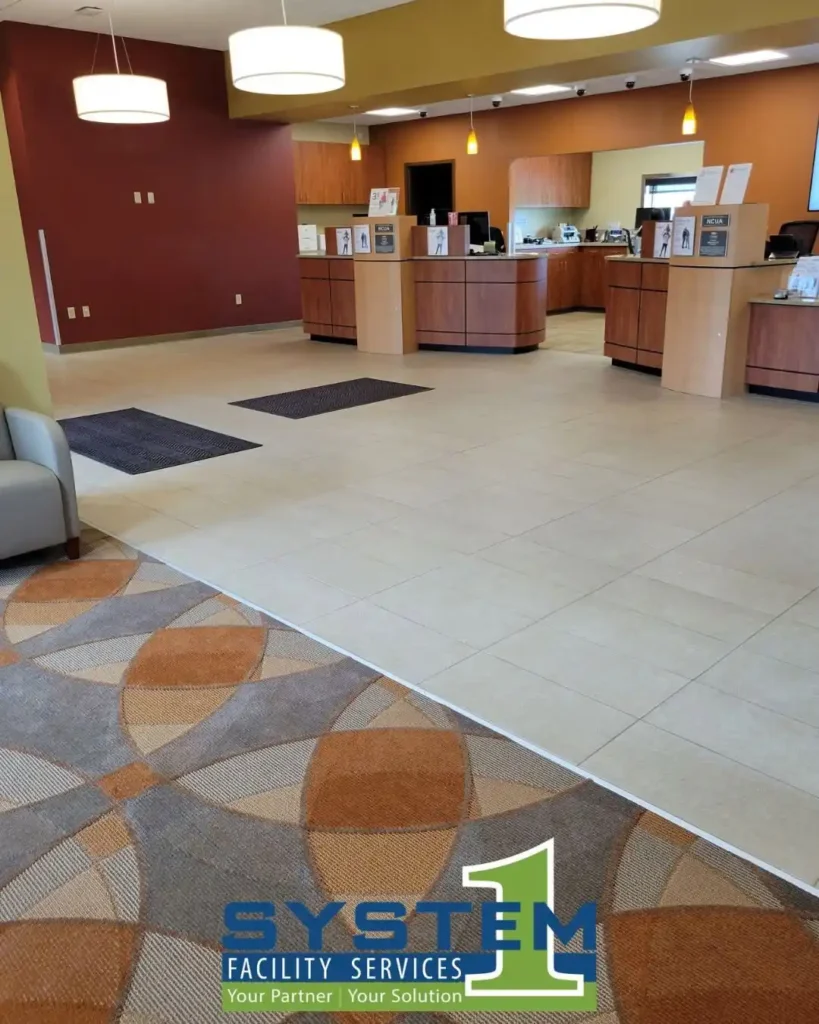
Occupational safety starts underfoot. OSHA’s Walking-Working Surfaces standard (29 CFR 1910.22) requires employers to keep places of employment, passageways, storerooms and service rooms clean, orderly and sanitary, and to inspect walking surfaces regularly. OSHA’s own housekeeping guidance flags wet floors during cleaning as a hazard in its own right, which is why the way cleaning is done matters as much as how often.
Employers face potential liability for unsafe conditions within their facilities.
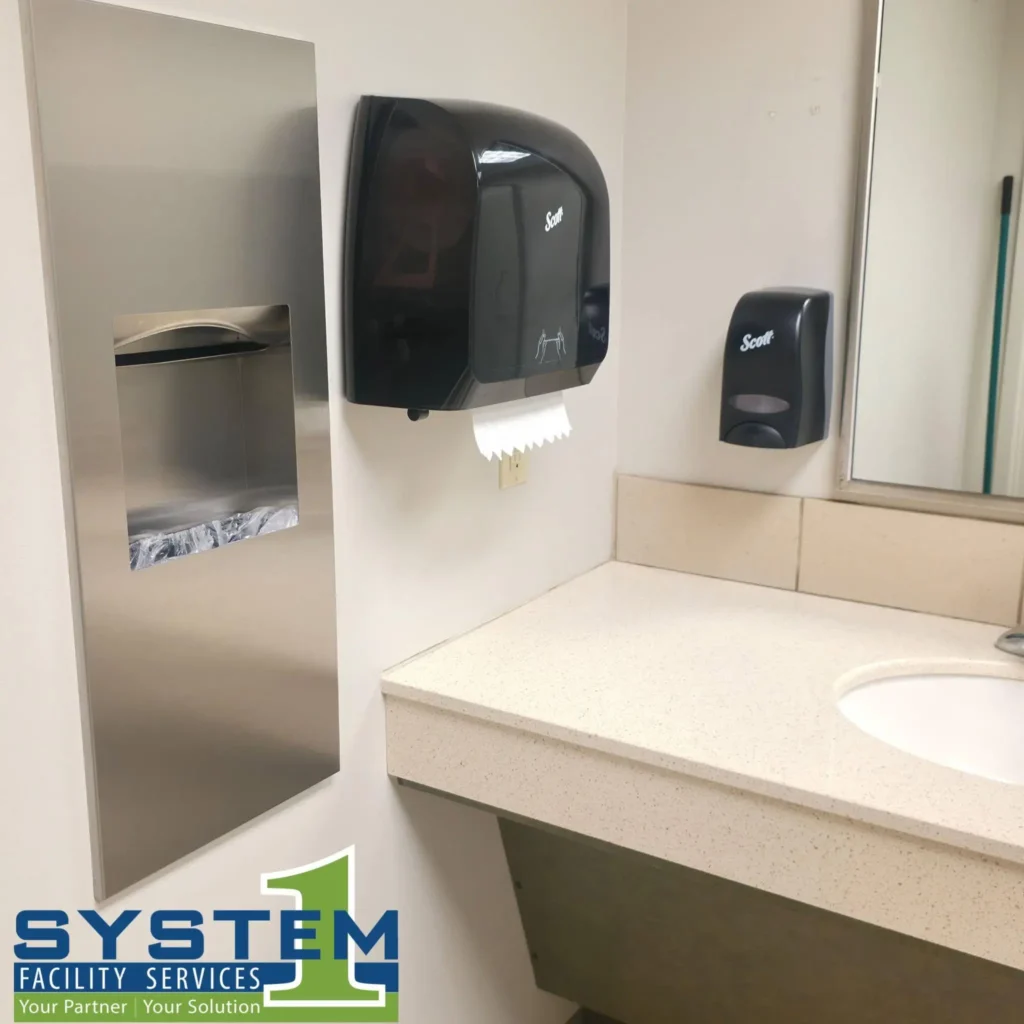
Cleanliness also supports a healthy environment. Poor hygiene spreads illness, drives absenteeism and can breach health and safety rules in sectors such as healthcare and food production. System1’s JanOPS® Operating System combines trained staff, sustainable products and documented processes into a tailored plan for each building, while its green cleaning service reduces chemical and pollutant sources indoors. For a deeper look, read our guide on how regular cleaning helps businesses meet OSHA standards.
Safe Handling of Hazardous Materials
Cleaning chemicals are hazardous materials, and improper handling can cause burns, eye injuries, breathing problems and dangerous spills. It is also one of the most common compliance gaps. OSHA’s Hazard Communication standard was the second most frequently cited standard in fiscal year 2025, with 2,546 violations. The usual failings were a missing written program, inadequate employee training and unlabeled containers.
This is where a professional provider’s safety program can play an important role in supporting a safer facility environment.
- Orientation for All New Hires: Health and safety training covering rules, task-specific prevention methods and how to report accidents.
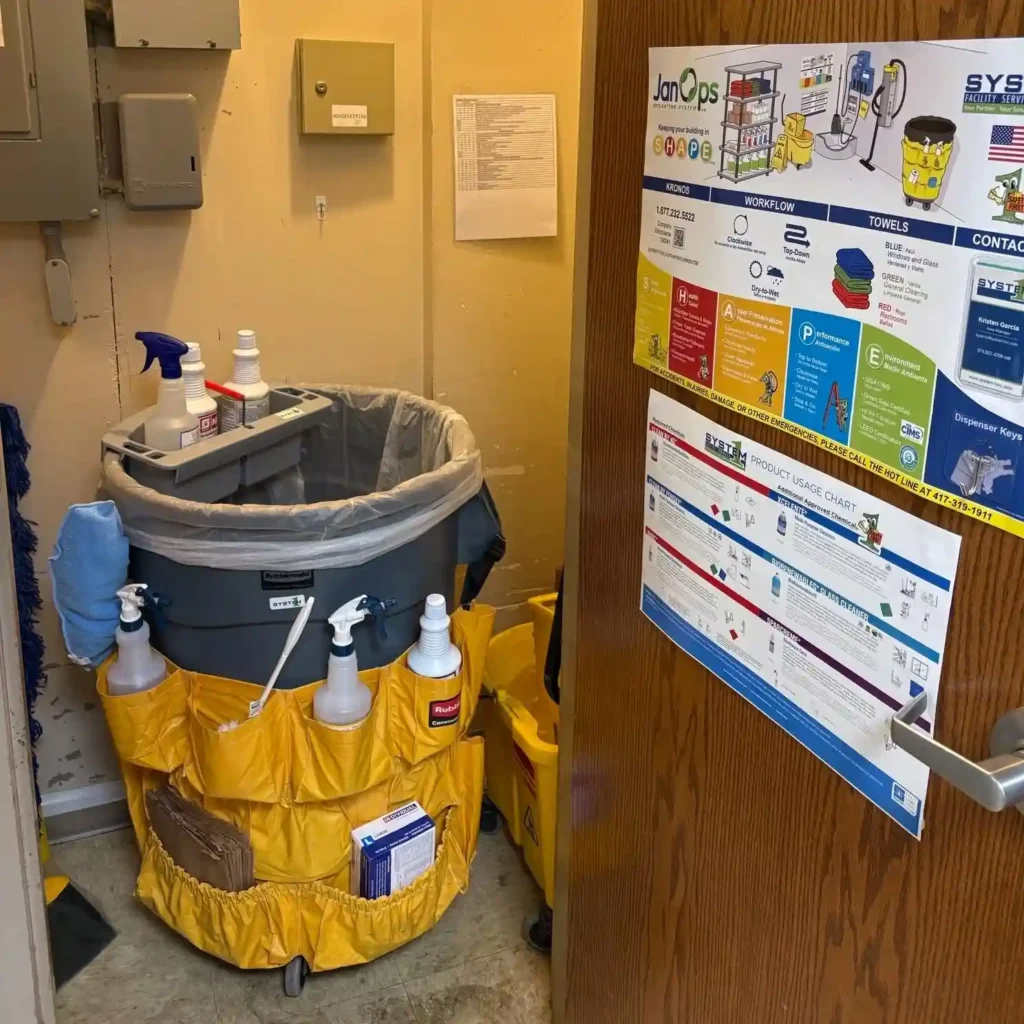
- OSHA-Required Training: Bloodborne pathogens, hazard communication and Safety Data Sheet (SDS) access, with SDS kept in all closets.
- Monthly Safety Meetings: Regular training on slips and falls, chemical spills and protective equipment.
- Visual Reminders: The “Safety Chief” program covers chemical labels, wet floors, lifting, ladders, eye protection, gloves and safety footwear.
- Clear Accident Procedures: Prompt incident reporting plus a formal return-to-work policy for injured employees.
- Fleet Safety: GPS-monitored vehicles and a safe driver program.
When these safety protocols are written down, trained and repeated, new employees learn the right habits from day one, and the chance of a chemical incident on your site is greatly reduced.
The People in Your Building: Hiring, Training and Access Control
A cleaning crew often has after-hours access to offices, records rooms, bank branches, patient areas and government facilities. That makes a provider’s hiring, screening, and training practices an important consideration when evaluating facility-related risks. Before signing a contract, ask any provider how it vets staff, what background checks it carries out, how it supervises new hires and how it handles keys, badges and alarm codes. Look for a clear process that also complies with federal anti discrimination laws.
Strong access control is equally essential. Agreed entry times, sign-in records and limited key holders reduce the chance of theft, data exposure or unauthorized entry, and they give you critical details to rely on if an incident is ever questioned.
At System1, we place training at the center of our staffing approach. Our extensive training programs give every employee a firm grasp of their role, and teams work from contract specifications so there is “zero guesswork” about what to do. The company also fosters an open and supportive culture where staff can voice concerns. Open communication and ethical behavior on the front line mean small problems get reported and fixed rather than hidden.
Data, Documentation and Proactive Risk Management
If an injury claim or inspection ever lands on your desk, the first question will be: what did you do to prevent it? Documented inspections, work orders, and compliance checks can provide valuable evidence of ongoing safety and maintenance efforts.
That is why facility management software has become central to proactive risk management. System1 uses CleanSmarts, a facility information system with online reporting and data that gives clients real figures on the status of their facilities rather than assumptions. Scheduling, time tracking, inspections and work orders sit in one system, and teams complete inspections and checklists on site using mobile devices. Work order tracking helps improve accountability and reduce the likelihood of unresolved issues.
The result is a proactive approach rather than a reactive one:
- Spot Trends Early. Recurring issues in one area point to potential risks before they cause injuries.
- Take Corrective Actions Fast. Work orders create a clear owner and a record of follow through.
- Make Data Driven Decisions. Facility managers can make informed decisions about budgets, staffing and priorities.
- Support Compliance Efforts. Digital reporting helps maintain records of inspections, service activities, and corrective actions that may support internal reviews, audits, and ongoing compliance efforts.
Regular reviews of this data drive continuous improvement in both safety and operational efficiency.
What Sets System1 Apart
Many organizations offer cleaning and maintenance. Fewer can demonstrate the experience, certifications, and documented systems that help employers manage facility-related risks with confidence.
Here is what makes System1 different:
- Decades of Heritage. System1’s roots go back to 1958, when Don Aslett founded Varsity. In 1992, Varsity’s leaders partnered with the late Bob Garcia to form a minority-owned contracting company, which grew into today’s national business. Read the company story.
- Independently Certified Quality. System1 holds ISSA CIMS –GB Honors certification, the cleaning industry’s management standard covering operations, performance systems and processes. It shows an organization can deliver quality service consistently.
- Certified Minority-Owned. NMSDC certification helps clients meet supplier diversity goals and strengthen their Tier 1 diversity spend.
- Active in the Industry. Partnerships with ISSA and BSCAI (Building Service Contractors Association International) keep teams current on best practices and help them stay ahead of changing regulations.
- Proven Systems. Our proprietary JanOPS® Operating System standardizes how work is done, and CleanSmarts reporting proves it was done.
- Experienced Leadership. President and CEO Robert Rayl brings more than 35 years in the industry.
- A Partnership Process. Every contract follows four steps: initial assessment, a customized facility strategy, expert facility procedures and ongoing quality assurance.
- Sector Experience. System1 serves banks, healthcare, government agencies, utilities, manufacturing, education and corporate offices, where compliance processes are often strict.
Building a Strategic Plan to Minimize Risk
Reducing liability is not a one-off project. It is a strategic plan built on good practices that are repeated every day. When you review your facility services, check that your provider offers:
- Documented safety protocols and procedures for every task.
- Regular training for staff, starting on day one.
- Clear guidelines for handling chemicals and hazardous materials.
- Secure access control and accountable staffing.
- Digital inspections and automated reporting that track facility conditions.
- Proof of certification against recognized industry standards.
The benefits extend well beyond reducing workplace hazards. Employees benefit from a cleaner, safer environment, managers gain greater visibility into facility conditions, and organizations can take a more proactive approach to identifying and addressing potential risks.
Reach Out Today
At System1, we have spent decades helping employers protect what matters most, with the trust and integrity behind our mission to be the number one facility service solution. To find out how a tailored facility plan can reduce your liability risks, contact our team today.